Building an 8-bit computer from logic gates, by hand
Senior Capstone Project · Engineering Pathway Capstone · High School Engineering Pathway · 2022 - 2023
It started with a game. Playing Turing Complete, I built a working computer from a single NAND gate up. Once I'd made an 8-bit machine in the game, I decided to build a real one, a physical 8-bit computer wired from simple logic gates on breadboards, inspired by Ben Eater's series.
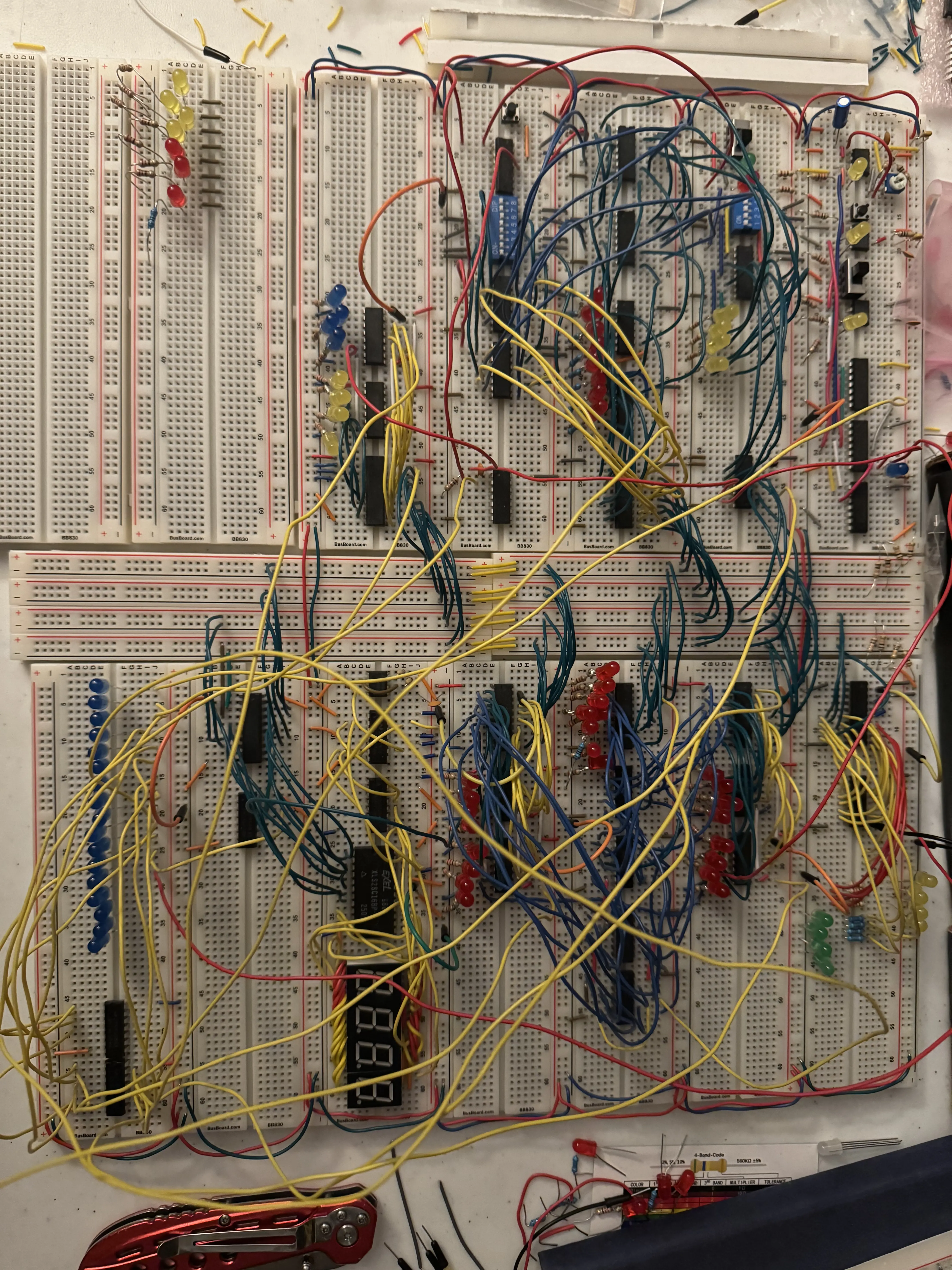
- Runs real assembly programs: add, subtract, load, store, and jump.
- 8-bit ALU with add and subtract arithmetic.
- Decimal output on a 7-segment display.
- Built from discrete logic gates, EEPROMs, and RAM on breadboards.
The problem
I wanted to actually understand how a computer works, not at the level of 'the CPU runs instructions,' but down to the gates. A simulator gets you part of the way; I wanted to bridge from the game to real, debuggable hardware on a bench.
That meant turning a stack of logic-gate ICs, EEPROMs, LEDs, and wire into a coherent machine: an ALU, registers, a program counter, RAM, a clock, control logic, and a display, all wired to talk to each other correctly.
What I built
- 1
Learn the fundamentals
I worked through Ben Eater's guide and studied schematics and digital logic: how AND, OR, NOT, NAND, NOR, and XOR gates behave, and how microprocessor architecture executes instructions and moves data between components.
- 2
Source the components
I bought and organized the parts: logic-gate ICs, breadboards, EEPROMs, LEDs, and a lot of wire, so I had the needed materials for each subsystem.
- 3
Wire, debug, repeat
I built it incrementally, wiring a component, debugging it, and repeating, then connected each individual component into one working machine. Debugging hundreds of jumper wires by hand was the real teacher.